Showing posts with label Portrait Drawing. Show all posts

Monday, January 25, 2016

Mixing Wet and Dry Media


Mixing wet and dry media can add tremendous texture and uniqueness to your portrait. Coating paper with water colors to tone your base (paper) and then going in with hatch marks, or cross-hatch marks when it's dry can make art seem more realistic or 3-dimensional (Thomas 19).

Side strokes with stump blending: 

Broad strokes with stump blending:

Which technique do you think would be used more often?

Thomas, Joy. The Art of Portrait Drawing: Learn the Essentials Techniques of the Masters. New York: F+W Media, 2012. Print.

Sunday, January 3, 2016

Drawing from Life

A traditional exercise for a portrait artist is the study of life like how shadows and lights move, and critical aspects of a smile (Thomas 22).

In this post I'm showing you all my attempt of drawing Jhene Aiko! From my previous posts, I was learning about the different techniques artists typically use when drawing a portrait, so I thought I should apply those techniques in my drawings as well. While working on this portrait I often found myself blending in a lot of parts of this picture, but first starting out with cross-hatch marks because it works more efficiently for me.

Some of the challenges I have faced were not knowing where to shade to make the face look more 3-dimensional since Jhene Aiko's face is naturally really clear, as in not having many wrinkles since she's young. This made my drawing look extremely one dimensional which isn't what I'm striving for as far as how I want to improve my drawings. So instead of shading a lot of areas on her face, I decided to stick with shading in her cheek bones and her eye make-up, under her lips, and around her neck to make her look alive. 
 
What are your thoughts on portraits of older women, or men? Do you think it would be more difficult?

Thomas, Joy. The Art of Portrait Drawing: Learn the Essentials Techniques of the Masters. New York: F+W Media, 2012. Print.


Wednesday, December 23, 2015

Drawing Techniques

Tradition methods of application can be easily used if acquiring helpful tools aren't easy. Some of the most used methods are hatching, cross-hatching, side stroking, and blending.

Hatching is when you draw very close parallel lines to achieve a good tone or shadow in a drawing.


Cross-hatching is the application of single hatch marks over previously drawn ones. To cross hatch myself, I added lines on top of the original hatch marks in the previous picture.


Side Strokes are accomplished by using the side of a pencil point or crayon to draw wide marks or a tone. Note the appearance of the side strokes is depending on the surface your drawing is supported with!

Blending is a useful way to achieve broad areas of a drawing. That being said, it's easily used to cover up large blank areas of a picture. The technique has been used for centuries to manipulate harsh edges. This can be tricky because using the blending technique too often can break the unity of a drawing, as it is said in the book: "Blending can destroy the integrity of a drawing, so it's important to avoid overusing this tenchique" (Thomas 13).


Now that you've seen a few drawing techniques, which of these do you think will create the best-looking portrait drawing?

Thomas, Joy. The Art of Portrait Drawing: Learn the Essentials Techniques of the Masters. New York: F+W Media, 2012. Print.


Monday, November 30, 2015

Portrait Drawing Materials


In Joy Thomas's The Art of Portrait Drawing, it is made very clear that having the right materials leads to a successfully drawn portrait, "It's challenging enough to create art without having to fight inadequate materials." Not having useful materials causes drawing to be challenging, especially drawing realistic portraits because there are so many aspects of the human face that you have to capture that can't be easily achieved by using one of your average go-to pencils.
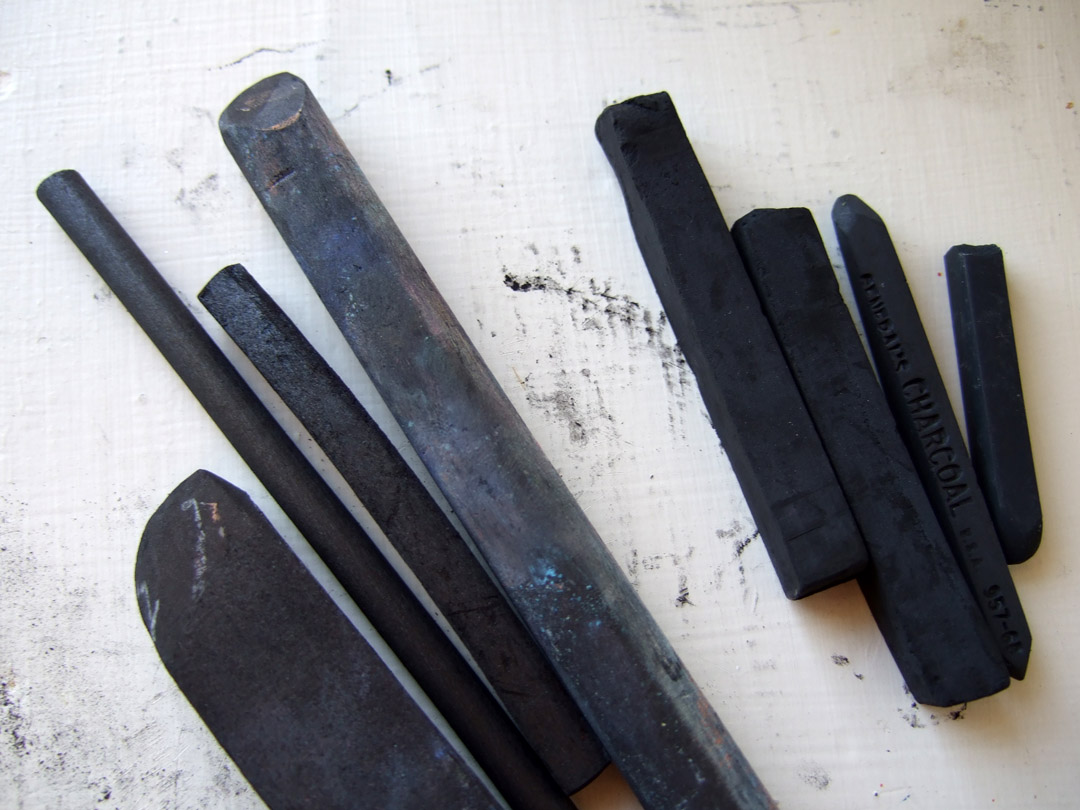
One of the materials that may be very useful while drawing is charcoal. Between vine and willow (two popular types of charcoal to use for drawing), willow will probably be the best choice because it has the best consistency, easy to manipulate or remove, and is used in preliminary work. It comes in many different varieties of shapes, textures, and sizes too! It's velvety dark mark is used for making broad stokes in your portrait, which makes it very easy to create large portraits if you wish to do so.

Other materials that may come in handy are subtractive tools. Although subtractive drawing may be mostly known as a beautified phrase for erasing, but there's more to it than that-it's about lifting the tone of the picture to shape form, adding a line-texture, or creating highlights to give a more three-dimensional look to your portrait. Retractable erasers, kneaded erasers, gum erasers, extra-soft erasers, single-edged razor blades, and bristle brushes are all counted as subtractive tools.

A few materials people may not know much about because of their goofy names are tortillions, stumps, and chamois cloths. These tools are a must for toning your portraits!

Lastly, graphite pencils, ink, and silverpoints are essential for creating a portrait. Graphite has been used for drawings for centuries! It comes in many different forms as well. Graphite pencils today are formed from a paste mixture of graphite, clay and water which after that, is fired. Inks are available in a whole spectrum of colors. Traditional favorite inks include the transparent and luminous brown-bistre and sepia. Ink drawings vary according to the tools and techniques used while forming a portrait. Silverpoints consist of a sharpened silver wire held by a stylus and is known for making precise marks.

Although having proper materials can be very helpful for drawing or sketching, do you think someone needs these many materials for one portrait? What are your thoughts on constantly replacing these items as soon as they are worn out?

Thomas, Joy. The Art of Portrait Drawing: Learn the Essentials Techniques of the Masters. New York: F+W Media, 2012. Print.

Monday, November 16, 2015

The Art of Portrait Drawing: Learn Essential Techniques of the Masters

For my IRP 2 project, I will be drawing realistic portraits and using Joy Thomas's The Art of Portrait Drawing: Learn Essential Techniques of the Masters to practice drawing people with realistic features. I've been drawing since I was a very little girl and I have a lot of experience drawing but drawing portraits is not something I'm completely comfortable with yet. I thought it will be interesting to explore great techniques other amazing artists use to draw portraits.

Thomas, Joy. The Art of Portrait Drawing: Learn the Essentials Techniques of the Masters. New York: F+W Media, 2012. Print.